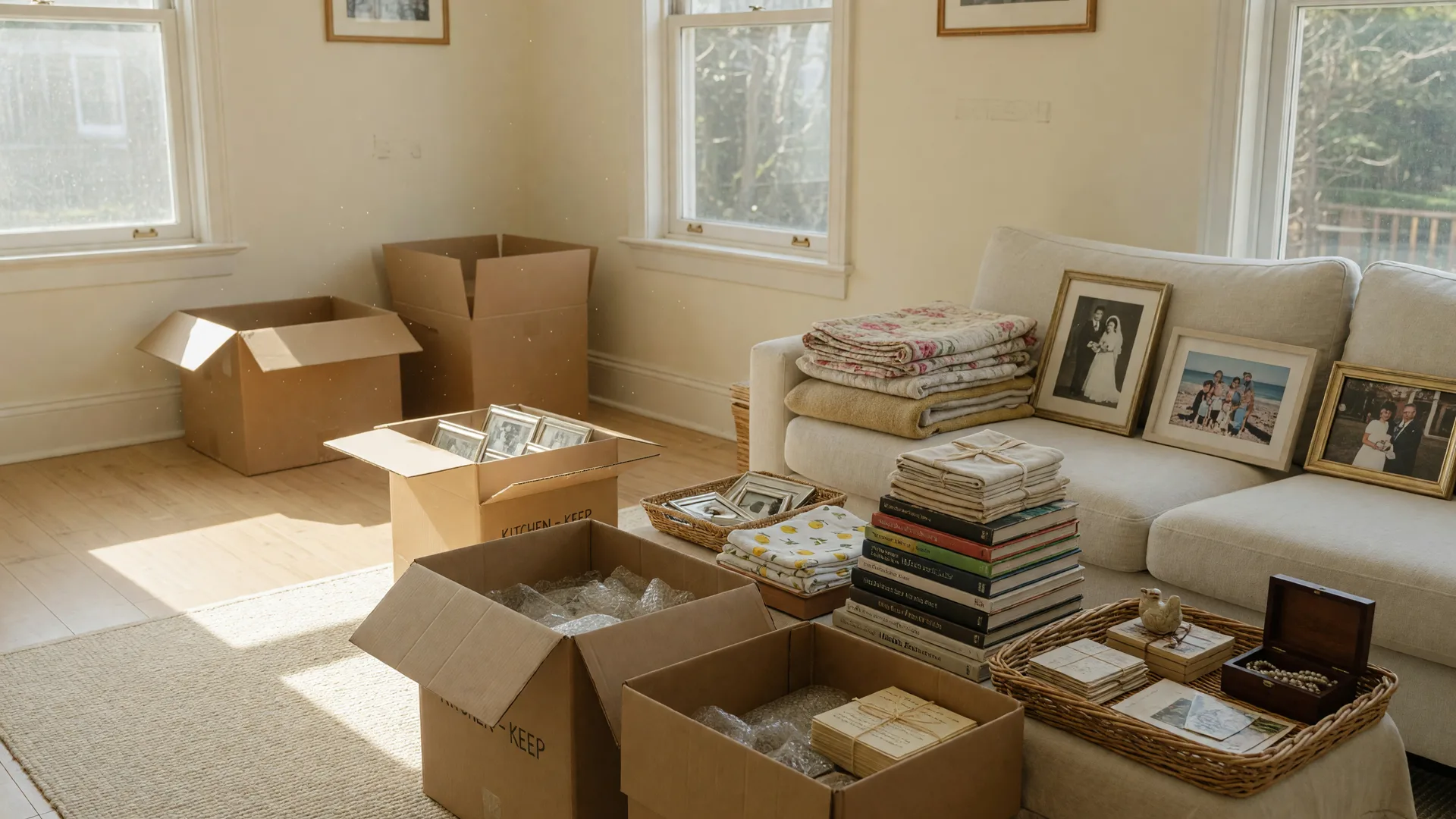
The stuff can be the hardest part of a senior move. A room-by-room plan for sorting keepsakes, dividing belongings fairly, and letting go without conflict.
I have watched families handle the belongings two ways: as a shared project that brings them closer, or as a silent contest nobody admits they are in. The difference is almost never the stuff. It is the plan.
The short answer
Every senior move has a moment when the family walks into the house and simply stops. The attic, the garage, the china cabinet, the boxes of photographs, the sewing room, the workshop, the holiday decorations that could fill a store.
Every senior move has a moment when the family walks into the house and simply stops. The attic, the garage, the china cabinet, the boxes of photographs, the sewing room, the workshop, the holiday decorations that could fill a store. Decades of a life, organized by nobody, waiting for a decision. The stuff is where transitions go to stall, and it is also where families either come together or quietly come apart. This post is a room-by-room plan for doing it well.
Why the stuff is really about feelings
The belongings are never just belongings. The dining room table is every Thanksgiving. The tool bench is Dad's hands. The jewelry box is Mom's mother. When siblings fight over the stuff, they are usually not fighting over the object; they are fighting over who mattered, who was remembered, and who gets to carry the family forward.
Naming that changes how you sort. It is why the process matters more than the outcome, and why the family should agree on the process before anyone touches a box. Decide together how decisions will be made, who will be included, and what Mom and Dad have already said about their things. Then the sorting itself can be calm, because the rules were set before the emotions arrived.
A room-by-room approach
Do not try to sort the whole house in a weekend. Work room by room, one room at a time, and finish each room before starting the next. Here is the order that tends to work:
Kitchen. Daily-use items first: dishes, cookware, small appliances, pantry. Keep what Mom will actually use in her new place. The good china is a decision for the family, not a default keep.
Living and dining rooms. Furniture, art, and the display pieces. Measure the new space before keeping large furniture; most assisted living and senior apartments are smaller than the family home.
Bedrooms. Clothing, linens, and personal items. Sort clothing by season and condition first, keep the comfortable favorites, and donate the rest. This is often the most emotional room, so go gently.
Garage, attic, and storage. Tools, holiday decorations, sports gear, and the boxes nobody has opened in years. Be honest: if it has not been opened in five years and nobody claims it, it is probably not coming to the new place.
Paperwork. Keep the documents that matter: deeds, tax returns, insurance, medical records, financial statements, and legal papers. Shred the rest. When in doubt about a document, ask the elder law attorney or CPA before discarding anything.
Divide the belongings fairly, as a family
Here is a process that has worked for families I have guided:
Sort into categories first. Keep, donate, sell, and undecided. Nothing gets claimed until the sorting is done.
Ask Mom and Dad what they want. If they can still choose, let them direct the meaningful items. Their wishes settle most disputes before they start.
Let each sibling write a short list. The few items that truly matter to each person, in order. Then take turns choosing from those lists, one item at a time, oldest to youngest or by coin flip, until the lists are satisfied.
Share instead of split. Some items can be photographed, copied, or shared. The family photo albums can be scanned so everyone has them. The memory does not have to live in a single garage.
The goal is not a perfectly equal division. It is a process where everyone felt heard, which is what the family will remember long after the boxes are gone.
Estate sale, donation, or storage: timing matters
Once the keepsakes are claimed, the rest of the house needs a destination, and the timing depends on the move:
Before the move. Sorting before Mom moves means she can be part of the decisions, the new place gets only what fits, and the family home is ready to show or sell without a second trip. This is almost always the better timing.
After the move. Sometimes the move happens first for care reasons, and the house is sorted later. It works, but the house carries costs while it waits, and sorting without Mom means more decisions made for her rather than with her.
Estate sale. A professional estate sale company prices and sells the usable contents in place. Good for a house being sold, and it handles the volume the family cannot.
Donation. Charities will pick up furniture and household goods. A clean, meaningful ending for items with modest resale value, and it can simplify the tax picture when documented properly.
Storage. Only for a short, defined period with a specific purpose. Storage costs money every month and postpones the decision, and too many families pay for a unit for years without ever opening it.
What to do with the house contents before selling
If the house is going to be sold, the contents need to be cleared before the first showing photos. Buyers cannot see past clutter, personal photos, and collections, and an empty or lightly furnished house photographs brighter and sells faster. That speed matters when the proceeds are funding care.
The full plan for the house itself is in the previous post in this series, selling Mom's house after she moves to assisted living, and a free home value estimate tells you what the house is worth before you invest in prep.
Letting go is a process, not a single day
Some families finish the whole house in two weekends. Most do not, and that is fine. The stuff took decades to accumulate, and it will not be sorted in a weekend without grief or conflict. Plan for several sessions, take breaks, and let each family member move at their own pace within the plan.
And remember the note from the rest of this series: for medical, legal, and care decisions, consult an elder law attorney, a geriatric care manager, and senior-care professionals. My lane is the property and the process, and I am glad to help the family keep the house, the stuff, and each other moving in the same direction.
Call or text me at 725-765-3346, email stevelockhart.lv@gmail.com, or visit stevelockhartrealtor.com.
Frequently Asked Questions
How do we divide Mom and Dad's belongings fairly between siblings?
Agree on the process before anyone starts taking things. A common approach: sort everything into categories first, let each sibling write a short list of the items that matter most to them, then take turns choosing, one item at a time, until the lists are satisfied. Ask Mom and Dad what they want certain items to go to while they can still say so. The goal is not perfect equality; it is that everyone feels heard.
Estate sale, donation, or storage: which should we choose?
It depends on the items and the timing. An estate sale company prices and sells the usable household contents in place, which works well when the house is being sold and the family wants the process handled professionally. Donations work for items with modest resale value and give the family a clean, charitable ending. Storage only makes sense for a short, defined period and a specific purpose, because it costs money every month and postpones the decision.
What do we do with the house contents before selling the home?
Clear the house before the first showing photos. Buyers cannot see past clutter, personal photos, and collections. Sort room by room, keep what the family is keeping, sell or donate the rest, and leave the house clean and neutral. A house that shows empty or lightly furnished photographs better and sells faster, which matters when the proceeds are funding care.
How do we handle sentimental items without anyone feeling hurt?
Name the feelings out loud instead of pretending they are not there. Let each family member take the items that carry personal memories, and agree that some items can be shared or photographed rather than fought over. If a specific item matters to more than one sibling, Mom and Dad's stated wishes, a coin flip, or a respectful rotation can settle it. The memory lives in the family, not only in the object.
This article is general information only and not legal or financial advice; for probate, estate, or tax questions, consult an elder law attorney and a CPA.
About the author
Written by Steve Lockhart, Las Vegas REALTOR® with First Mutual Realty Group (Nevada license S.0194053), member of the National Association of REALTORS, and creator of The Lockhart Method™.
This article is general information only and is not tax, legal, or financial advice. Your situation deserves a conversation with the right professionals before you act.
Related Articles
More on Life Transitions
 Life Transitions
 The Thanksgiving Conversation: When You Realize Mom Needs More Help
You notice at Thanksgiving that Mom is not moving the same. Here is how to start the conversation about assisted living without ambushing her, as a family.
 Life Transitions
 Where Do We Start? A Senior Transition Checklist for Adult Children
After a fall or a hard conversation, the family realizes Dad cannot stay alone and nobody knows where to start. Here is a practical first-30-days checklist.
 Life Transitions
 Can You Afford to Keep the House in a Divorce? The Real Math
Keep, sell, or buy out the family home in a divorce? The real math on value, equity, mortgage qualification, buyouts, and the ongoing costs of keeping it.
The next step
Want this applied to your situation?
The article is the context; the consultation is the strategy. Bring your question, and we will develop a plan that works for you, in plain language, without pressure.
Schedule a Consultation