Translate
Selling a House During a Nevada Divorce: The Timeline, the Process, and What Nobody Tells You Until It's Too Late
It is 11pm. You are lying awake running numbers in your head — the mortgage, the equity, what the house is actually worth, who gets what. You Google "selling a house during a divorce in Nevada" and get a wall of legal jargon that answers nothing and scares you more.
In my years working with clients navigating divorce in Las Vegas, Henderson, and Summerlin, the house is almost always the most emotionally loaded and financially complex piece of the puzzle. And the process? Almost nobody explains it clearly until you are already deep in it.
This is the guide I wish every client had before they called me. No legal jargon. Just the real sequence of events, the decisions you will face, and what to watch out for.
Nevada is a community property state — and that single fact changes everything about how your home gets handled in a divorce.
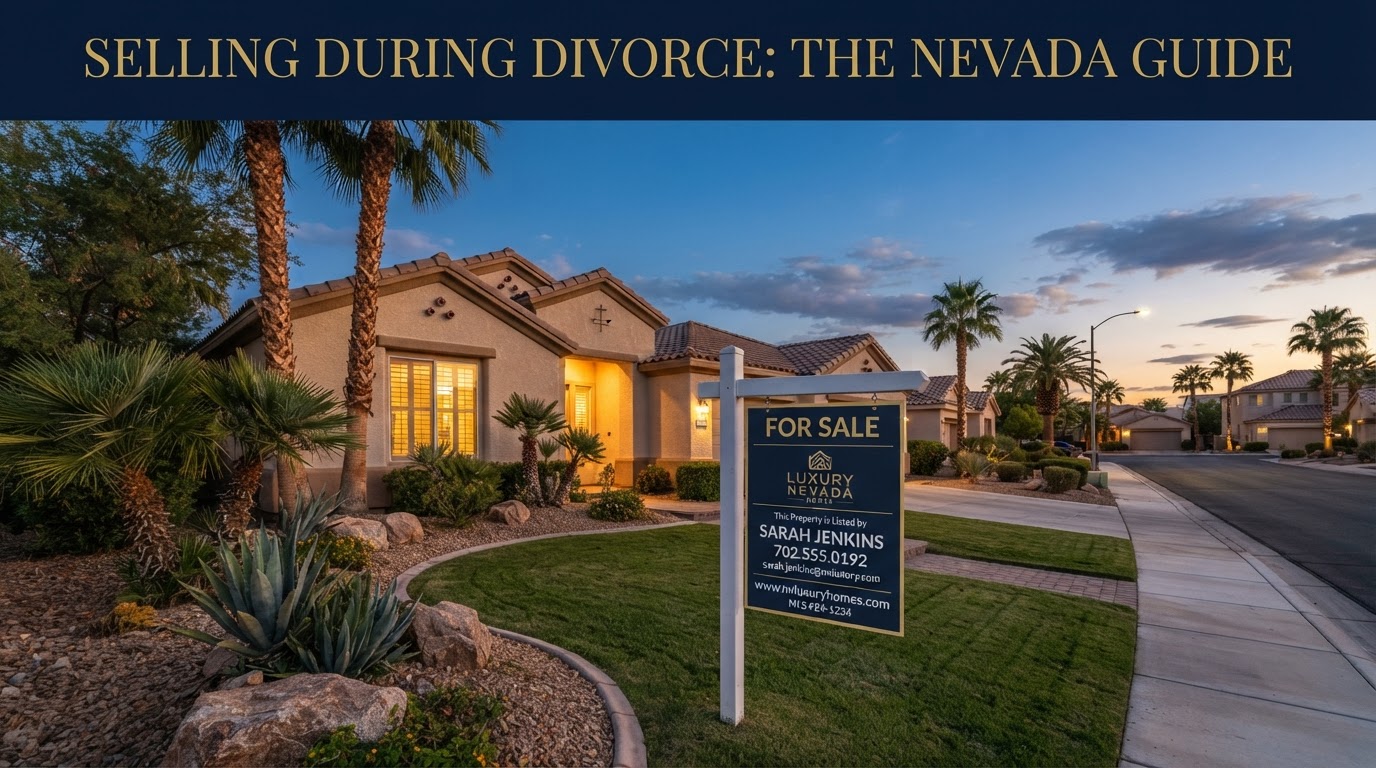
A Las Vegas neighborhood at dusk. In Nevada community property law, the equity in homes like these is typically split 50/50 between spouses.
First, Understand Nevada's Community Property Law
Nevada is one of 9 community property states — this is NOT common knowledge; most people assume it works like wherever they moved from.
What community property means: assets (and debts) acquired during the marriage are owned 50/50 by default. The house is almost always community property — UNLESS purchased before marriage, inherited, or received as a gift (separate property). Separate property must be clearly documented — commingling can convert it to community property.
Key point: being on the deed or the mortgage does NOT determine ownership in Nevada — the marriage date does. Practical consequence: both spouses typically have equal legal right to the proceeds from the sale.
Clark County processes thousands of divorce cases annually — and in a majority of them, real estate is the single largest marital asset in dispute.
I have worked with clients who assumed the house was 'theirs' because their name was on the deed — only to discover that their spouse had equal claim to every dollar of equity. Understanding this before you list the home can save months of conflict.
The 4 Options for the Marital Home in a Nevada Divorce
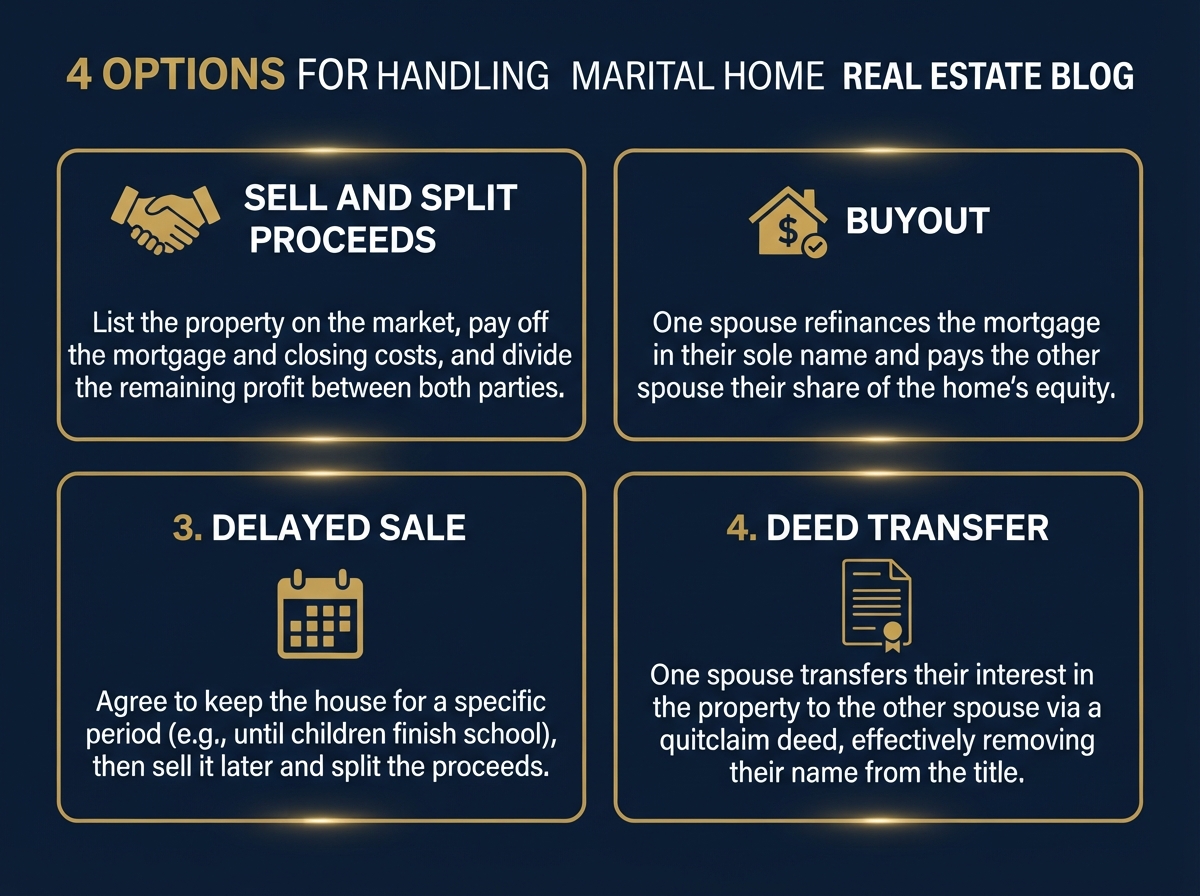
The four paths for your marital home during a Nevada divorce. Each has different financial, tax, and emotional implications.
Make this a clean, scannable breakdown. Each option gets a short paragraph:
Option 1: Sell the Home and Split the Proceeds
Most common outcome in contested and uncontested divorces. Both parties agree to list, sell, and divide equity after mortgage payoff, agent fees, and closing costs. Cleanest financial break — often recommended by both attorneys and financial advisors. Requires cooperation on pricing, timing, and showing access.
Option 2: One Spouse Buys Out the Other
One party keeps the home, refinances the mortgage into their name alone, and pays the other their equity share. Requires the buying spouse to qualify for a new mortgage independently — lenders look at income, credit, DTI ratio. If they cannot qualify: this option is off the table regardless of what both parties want.
Option 3: Delayed Sale (Deferred Transfer)
A court can order the home to remain unsold — often when minor children are involved and stability matters more than immediate equity. One spouse stays in the home until a trigger event (kids graduate, remarriage, a fixed date). Complex — both parties remain financially tied to the property during this period.
Option 4: One Spouse Deeds Property to the Other (No Cash Buyout)
Rare — usually used when equity is minimal or negative, or as part of a larger asset trade-off. Requires quitclaim deed and proper legal documentation.
Each option has tax implications, mortgage implications, and emotional weight. I always recommend my clients consult with both a Nevada family law attorney and a CPA before locking in their choice — I am here to make sure the real estate side is handled cleanly regardless of which path you take.
The Timeline — What Actually Happens and When
This is the section most people cannot find anywhere. Here is what actually happens, step by step:
Retaining Counsel and Initial Asset Disclosure (Weeks 1–4)
Both parties disclose all assets. The home gets listed on the financial disclosure. An appraisal or comparative market analysis (CMA) may be ordered by the court or requested by attorneys.
Deciding the Home's Fate — Negotiation or Court Order (Weeks 4–16+)
This is where it gets unpredictable. If both spouses agree on what to do with the home, this step is fast. If not, it goes to mediation or the judge decides. Contested home decisions can add months to the process.
Court Order or Settlement Agreement Locks In Terms (Varies)
Once the marital settlement agreement (MSA) or court order specifies what happens to the home, you have your roadmap. This document will govern everything — listing price approval, who signs documents, how proceeds are disbursed.
Listing and Selling the Property (~30–90 Days Depending on Market)
In the current Las Vegas market, well-priced homes move quickly — but divorce sales require both parties to cooperate on access, staging, and pricing decisions. A neutral REALTOR who works with both parties — not as an advocate for either — is essential here.
When I work with divorcing clients, I serve both parties as a neutral real estate professional. My job is to get the home sold for maximum value, on the best timeline, with the fewest complications — not to take sides. That neutrality matters more than people realize.
Closing and Proceeds Disbursement
Closing proceeds go to escrow. After the mortgage is paid off and closing costs deducted, the remaining equity is distributed per the MSA or court order. Sometimes this requires both parties to sign at closing — coordination matters.
Title Transfer or Deed Recording
If one party is keeping the home, the deed transfer must be properly recorded. Quitclaim deeds, interspousal transfer deeds, and proper title insurance are not optional details — they are the difference between a clean close and years of legal exposure.

A neutral, professional approach to discussing real estate during divorce keeps emotions from derailing the transaction.
The average Nevada uncontested divorce takes 3–6 months. A contested divorce involving real estate disputes can stretch to 12–18 months or longer. The single biggest variable? How quickly both parties agree on the home.
The Things Nobody Tells You (Until It's Too Late)
This is the insider knowledge section — the things most people discover only after they have already made mistakes.
Nobody Tells You: Your Mortgage Doesn't Disappear Just Because One Spouse Leaves
Even if your spouse moves out and your attorney has a signed separation agreement, if both names are on the mortgage, both credit scores are at risk if payments are not made. The lender does not care about your divorce — only about payment.
Nobody Tells You: Refinancing Is Harder Than It Looks
A buyout requires refinancing. Refinancing requires income verification, credit qualification, and current appraisal value. Many buyout plans fall apart at this step — and the couple is back to selling anyway, months later.
Nobody Tells You: Nevada's Automatic Stay on Assets Matters
Once a divorce is filed, both parties may be restricted from selling, transferring, or encumbering marital assets — including the home — without court approval. Listing a home without understanding this can create legal exposure.
Nobody Tells You: The Fair Price and Market Price Are Not Always the Same
Divorce can create urgency — and urgency costs equity. I have seen clients leave $30,000–$50,000 on the table by rushing a sale before the market was optimized. Pricing strategy matters even more in a divorce sale because neither party can afford to lose equity.
Nobody Tells You: You Need a REALTOR Who Has Done This Before
A divorce sale is not a standard transaction. There are two clients, potentially two attorneys, possibly a court order governing terms, and guaranteed emotional turbulence. The wrong agent makes everything harder.
I have been the REALTOR in the middle of some difficult situations. What I can tell you is this: when both parties feel heard, informed, and fairly treated in the real estate process — the whole divorce moves faster. My job is to be the one steady, professional constant in an otherwise chaotic season.
The Book I Recommend to Every Divorcing Homeowner
There is a book I have started recommending to every client navigating a divorce that involves real estate. It is called Divorce Is Emotional. Property Is an Asset.: How to Sell the Marital Home, Protect Your Equity, and Rebuild Stability by Michel Anthone — and it is one of the clearest, most practical guides I have found on this exact topic.
What I love about it: it does not sugarcoat the emotional reality, but it also does not let the emotion become an excuse for bad financial decisions. The title says it perfectly — your feelings about this marriage, this house, and this moment are real and valid. AND the property is still an asset that deserves a strategy.
At 174 pages, it is short enough to read in a weekend. And if you are going through this, it is one of the best $15 investments you will make in protecting your financial future.
Get the Book
Divorce Is Emotional. Property Is an Asset.
by Michel Anthone — available on Amazon
How to Choose the Right REALTOR for a Nevada Divorce Sale
Not every agent is equipped to handle a divorce sale. Here is what to look for:
- They must be comfortable working with both parties — not just the one who calls first
- They need to understand Nevada community property law at a working level (not a legal level)
- They should have a documented process: how are showings approved? Who signs what? How are price reductions decided?
- They should be able to communicate with both attorneys — not just the spouse they like
- They should have experience pricing and marketing homes under time pressure without sacrificing equity
- They should have zero financial or personal loyalty to either party
If you are looking for that REALTOR in Las Vegas, Henderson, Summerlin, or the surrounding areas — I would be honored to have a conversation. No pressure, no pitch. Just a clear-eyed conversation about your situation and your options.
Ready to Talk? Here Is Your Next Step
You do not have to have this all figured out before you call. In fact, the earlier we talk, the more options you have. Whether you are just exploring, your attorney just asked about the home's value, or you are ready to list — I am here to give you clear information, not a sales pitch.
Start with the book if you are not ready to talk yet. Understanding your situation clearly is the first step toward navigating it wisely.
📖 Divorce Is Emotional. Property Is an Asset. — Michel Anthone, Amazon
About the Author
Steven D. Lockhart is a licensed Nevada REALTOR® (License #S.0194053) specializing in residential listings, buyer representation, and real estate solutions for life transitions including divorce, probate, and senior relocations. Based in Las Vegas, NV, he serves the greater Las Vegas Valley including Henderson, Summerlin, North Las Vegas, and surrounding communities. Learn more at stevelockhartrealtor.com.
Legal Disclaimer: This post is for informational purposes only and does not constitute legal advice. Nevada divorce law is complex and situation-specific. Always consult with a licensed Nevada family law attorney regarding your specific circumstances.
Related resources: Divorce Real Estate Services, Selling During Divorce Guide, Seller Resources, Current Market Update

Steve Lockhart
Las Vegas Real Estate Strategist
Steve Lockhart spent nearly 30 years in MGM Resorts executive leadership, from the opening team of The Mirage to Director of Slot Operations at MGM National Harbor, before becoming a Las Vegas Realtor® in 2021. He built The Lockhart Method™ to bring that same high-stakes negotiation and leadership experience to real estate's toughest transitions: divorce, probate, senior downsizing, and distressed property sales.
Learn More About Steve