 Translate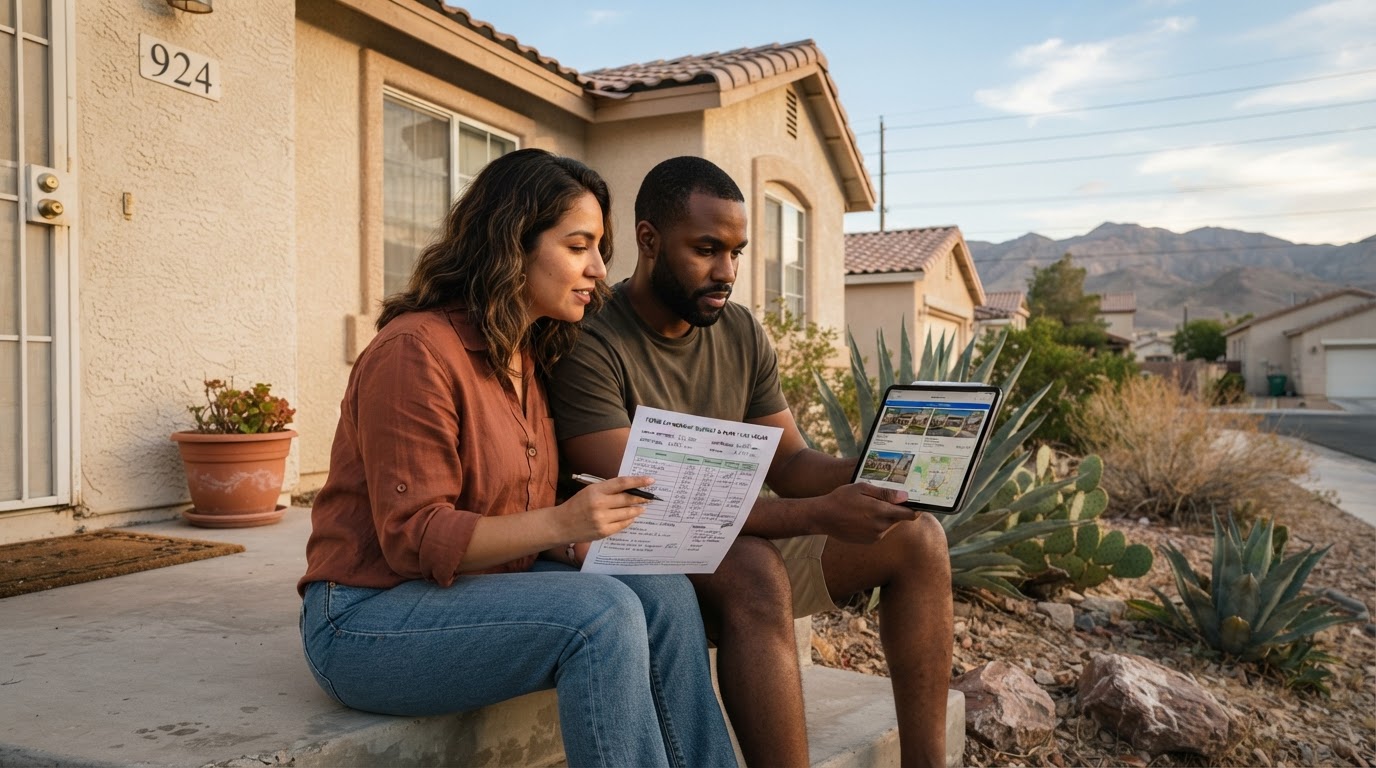
Renting in Las Vegas vs. Buying Your First Home in 2026: The Real Numbers That Change Everything
If you are renting in Las Vegas right now, you are likely paying between $1,600 and $2,200 a month for a standard two-bedroom apartment. Over five years, that is $96,000 to $132,000 in rent payments that build zero equity. Meanwhile, a typical Las Vegas mortgage payment on a $400,000 home with current rates and down payment assistance can land in a similar monthly range. The question is not whether you can afford to buy. The question is whether you can afford not to.
I have worked with first-time buyers across Las Vegas, Henderson, North Las Vegas, and Summerlin who told themselves 'not yet' for months or even years. When we finally ran the numbers together, most of them discovered the gap between renting and buying was smaller than they thought, and the programs available to help were more generous than they knew existed.
This article does the math honestly. No hype. No pressure. Just the real numbers for Las Vegas renters in 2026, the Nevada programs most people do not know about, and the questions that actually matter when deciding whether this is your year.
For many Las Vegas renters, the monthly gap between renting and buying is smaller than they think.
Is It Cheaper to Rent or Buy in Las Vegas Right Now?
The honest answer depends on your timeline, your down payment, and your tax situation. But let us look at the real numbers for a typical Las Vegas renter comparing a two-bedroom apartment rental to buying a $400,000 single-family home.
According to RentCafe, the average rent for a two-bedroom apartment in Las Vegas as of mid-2026 is approximately $1,750 per month. Some submarkets like Summerlin and Henderson run higher, while North Las Vegas and Enterprise run lower. For a single-family home rental, you are typically looking at $2,000 to $2,500 per month.
Now let us look at the buying side. Using a $400,000 purchase price, which is close to the current Las Vegas metro median, here is what a realistic monthly payment looks like with a conventional loan:
| Cost Component | Monthly Amount | Notes |
|---|---|---|
| Principal & Interest | $2,100 | 6.5% rate, 5% down, 30-year fixed |
| Property Taxes | $233 | ~0.7% annual rate (Nevada average) |
| Homeowners Insurance | $100 | Typical Las Vegas range |
| PMI (5% down) | $167 | Required under 20% down |
| HOA (if applicable) | $50–$150 | Varies by community |
| Total Monthly | $2,650–$2,750 | Before tax benefits |
Estimates based on mid-2026 Las Vegas market conditions. Actual rates and costs vary. Consult a mortgage professional for current figures.
At first glance, buying looks more expensive. But here is what that comparison misses: the tax deduction on mortgage interest, the principal portion of your payment that builds equity, and the fact that your mortgage payment stays fixed while rent increases every year.
Renting in Las Vegas builds your landlord equity, not yours. Over five years, that adds up significantly.
According to Zillow's Las Vegas rent index, rents have increased approximately 4-5% annually over the past several years. A $1,750 monthly rent today becomes approximately $2,125 in five years at that rate. Your mortgage payment stays exactly the same. Over ten years, the renter has paid over $250,000 in rent with zero equity, while the homeowner has built significant equity through principal paydown and home value appreciation.
Plain-language takeaway: On a pure monthly cash flow basis, renting is cheaper in 2026. On a long-term wealth-building basis, buying wins decisively. The decision comes down to how long you plan to stay and whether you can manage the upfront costs.
What Programs Exist for First-Time Home Buyers in Nevada?
This is where most renters get surprised. Nevada has several programs designed specifically to make first-time homeownership more accessible, and many of them are not widely advertised. Here are the programs I see most often help my clients:
Nevada Housing Division — Home Is Possible (HIP)
The Nevada Housing Division offers the Home Is Possible program, which provides down payment assistance grants to qualified first-time and repeat homebuyers. The program offers up to 5% of the loan amount as a forgivable grant that does not need to be repaid if you live in the home for the required period. Income limits apply and vary by county, but Clark County limits are generous enough to cover most working professionals.
NHD Home Is Possible for Heroes
If you are a veteran, active-duty military, firefighter, police officer, or teacher, Nevada offers an enhanced version of the HIP program with even lower interest rates and additional down payment assistance. Given the significant military and first-responder population in the Las Vegas Valley, this program is widely applicable.
FHA Loans
FHA loans allow down payments as low as 3.5% with credit scores starting at 580. For a $400,000 home, that is $14,000 down instead of the $80,000 a conventional 20% down payment would require. FHA loans are not just for first-time buyers, but they are one of the most common paths to first-time homeownership in Las Vegas.
VA Loans
If you are a veteran or active-duty military, VA loans offer 100% financing with no down payment required. There is no PMI. The VA funding fee can be financed into the loan. For Las Vegas, which has a large military and veteran population, this is one of the most powerful homeownership tools available. You can learn more about VA buyer resources on our site.
Clark County Down Payment Assistance
Clark County and the City of Las Vegas periodically offer additional down payment assistance programs funded by federal HUD grants. These programs are income-restricted and have limited funding windows, but when available, they can provide $15,000 to $25,000 or more in assistance. Check current availability through the down payment assistance page on our site.

Nevada offers several first-time buyer programs that most renters do not know exist.
How Much Do You Need for a Down Payment on a House in Nevada?
This is one of the biggest misconceptions I encounter. Most renters believe they need 20% down. That is not true and has not been true for a long time.
Here is what you actually need:
- Conventional loan: As low as 3% down. On a $400,000 home, that is $12,000.
- FHA loan: 3.5% down. On a $400,000 home, that is $14,000.
- VA loan: 0% down. No down payment required for qualified veterans.
- With Nevada down payment assistance: Your out-of-pocket down payment can be reduced to near zero, depending on program eligibility.
But the down payment is not the only upfront cost. You also need to account for closing costs, which typically run 2% to 5% of the purchase price. On a $400,000 home, that is $8,000 to $20,000. However, some programs allow seller concessions to cover closing costs, and the Nevada Housing Division programs can include closing cost assistance.
Total Cash Needed to Buy a $400,000 Home in Las Vegas
With an FHA loan and Nevada down payment assistance, a qualified first-time buyer may need as little as $8,000 to $15,000 total out of pocket, including down payment and closing costs. Without assistance, the range is typically $20,000 to $30,000. Compare that to five years of rent at $1,750/month: $105,000, with zero equity to show for it.
What Is the Average Mortgage Payment in Las Vegas in 2026?
Based on the current Las Vegas median home price of approximately $434,725 (per GLVAR data through the first half of 2026) and current mortgage rates in the 6.25% to 7% range, here is what a realistic monthly payment looks like at different price points:
| Home Price | Down Payment (3.5%) | P&I @ 6.5% | Total Monthly (est.) |
|---|---|---|---|
| $350,000 | $12,250 | $1,718 | ~$2,200 |
| $400,000 | $14,000 | $2,100 | ~$2,650 |
| $450,000 | $15,750 | $2,487 | ~$3,000 |
| $500,000 | $17,500 | $2,875 | ~$3,400 |
Estimates include principal, interest, taxes, insurance, and PMI. Actual rates and costs vary. Consult a mortgage professional for current figures.
For a first-time buyer targeting a $350,000 to $400,000 home, which is achievable in communities like Aliante, Enterprise, or Spring Valley, the total monthly payment lands in the $2,200 to $2,650 range. That is higher than the average rent, but you are building equity with every payment.
Can You Buy a House in Las Vegas with Low Income?
Yes, and more people qualify than realize it. The Nevada Housing Division programs are specifically designed for moderate-income households. For Clark County, the income limits for the Home Is Possible program are generous enough to cover most working professionals, not just low-income buyers.
Here is what matters more than income alone:
- Your debt-to-income (DTI) ratio matters more than your raw income. Lenders want your total monthly debts, including the new mortgage, to be under 43% of your gross monthly income. If you earn $60,000 a year ($5,000/month gross), you can potentially qualify for a total monthly debt load of $2,150.
- Your credit score determines which programs you qualify for. FHA loans start at 580. Conventional loans typically start at 620. The Nevada Housing Division programs have their own credit requirements, generally looking for 640 or above.
- Your employment history should show two years of consistent income. Self-employed buyers can qualify, but the documentation requirements are more involved.
- Down payment assistance does not require high income. In fact, some programs are specifically designed for buyers below area median income, which in Clark County is approximately $82,000 for a household.
If you are unsure whether you qualify, the best first step is a pre-approval conversation with a lender who works with Nevada first-time buyer programs. You may be surprised by what you qualify for.
The Hidden Cost of Waiting: What Renting Actually Costs You
Let me show you the math that changes most renters' minds. This is not a sales tactic. It is arithmetic.
Consider a Las Vegas renter paying $1,750/month. Over five years, that is $105,000 in rent. Over ten years, $210,000 (assuming rent stays flat, which it will not). Every dollar goes to the landlord. You build zero equity. You have zero tax benefits. And when you move, you have nothing to show for it.
Now consider a buyer who purchases a $400,000 home with 5% down. In the first year, approximately $3,600 of their mortgage payments go toward principal, building equity. Over five years, that grows to roughly $20,000 in principal paydown. Additionally, if the home appreciates at a conservative 3% annually, the home's value increases by approximately $63,000 over five years. Combined, the homeowner has built approximately $83,000 in equity in five years, while the renter has spent $105,000 with zero return.
Five-year comparison: Renter spends $105,000 with $0 equity. Buyer builds approximately $83,000 in equity while making similar monthly payments. The renter is behind by $188,000 after five years. That gap grows every year you wait.
There is also the tax benefit. Mortgage interest and property taxes are deductible on your federal return if you itemize, which can reduce your effective monthly payment by several hundred dollars. A mortgage calculator that does not account for tax savings overstates the true cost of ownership. You can run your own numbers using our Las Vegas mortgage calculator.
When Renting Actually Makes Sense
I am not going to pretend buying is always the right answer. It is not. Here is when renting is genuinely the better choice:
- You plan to move within two years. The transaction costs of buying and selling typically exceed any equity you would build in that timeframe. If your job, family situation, or plans are uncertain in the near term, renting gives you flexibility.
- Your credit needs significant repair. If your credit score is below 580, take six to twelve months to improve it. The interest rate difference between a 580 and a 700 credit score can mean tens of thousands of dollars over the life of a loan.
- You do not have any savings. Even with down payment assistance, you need some cash for closing costs, inspections, and moving expenses. If your savings are at zero, focus on building a reserve first.
- You are in a major life transition. Divorce, career change, or a pending relocation all create uncertainty. Renting through the transition gives you time to make a clear-headed decision about where you want to live long-term.
The Lockhart Method: Diagnose Before You Decide
The first phase of The Lockhart Method is Diagnose. Before you decide whether to buy or keep renting, I want you to understand your real position. That means looking at your income, your debts, your credit, your savings, and your timeline together, not in isolation.
For renters considering homeownership, Diagnose means getting pre-approved to see what you actually qualify for, not what you assume you qualify for. It means understanding which Nevada programs you are eligible for. It means looking at neighborhoods where your budget actually works, rather than dreaming about communities that are out of reach.
The goal is not to pressure you into buying. The goal is to give you the information you need to make the right decision at the right time for your situation. Some of my consultations end with the client deciding to wait six months. That is a valid outcome. What is not valid is waiting out of fear or misinformation.
Frequently Asked Questions
Is it cheaper to rent or buy in Las Vegas right now?
On a monthly cash flow basis, renting is typically cheaper in 2026, with average two-bedroom rents around $1,750 versus total mortgage payments of $2,200 to $2,750. However, on a long-term wealth basis, buying wins significantly due to equity building, appreciation, and tax benefits. Over five years, a buyer can build approximately $83,000 in equity while a renter spends $105,000 with zero return.
What programs exist for first-time home buyers in Nevada?
Nevada offers the Home Is Possible (HIP) program through the Nevada Housing Division, which provides down payment assistance grants of up to 5% of the loan amount. Additional programs include Home Is Possible for Heroes for veterans and first responders, FHA loans with 3.5% down, VA loans with zero down, and periodic Clark County down payment assistance programs. Income limits apply but are generous enough to cover most working professionals.
How much do you need for a down payment on a house in Nevada?
You do not need 20% down. Conventional loans allow as little as 3% down ($12,000 on a $400,000 home). FHA loans require 3.5% down ($14,000). VA loans require zero down for qualified veterans. With Nevada down payment assistance programs, your out-of-pocket down payment can be reduced to near zero. Total upfront costs including closing costs typically range from $8,000 to $30,000 depending on the program.
What is the average mortgage payment in Las Vegas in 2026?
For a $400,000 home with 3.5% down at a 6.5% interest rate, the total monthly payment including principal, interest, taxes, insurance, and PMI is approximately $2,650. For a $350,000 home, it is approximately $2,200. For a $450,000 home, approximately $3,000. Actual payments vary based on rate, down payment, HOA, and property tax rates. Use our mortgage calculator for a personalized estimate.
Can you buy a house in Las Vegas with low income?
Yes. Nevada Housing Division programs are designed for moderate-income households, with Clark County income limits generous enough to cover most working professionals. What matters more than raw income is your debt-to-income ratio (under 43%), credit score (580+ for FHA, 620+ for conventional), and employment history. Down payment assistance programs are specifically designed for buyers below area median income.
The moment it becomes real: first-time buyers receiving the keys to their Las Vegas home.
Ready to See What You Actually Qualify For?
If you have been telling yourself 'not yet' for months, the most productive thing you can do is get the real numbers. Not estimates from an online calculator. Real numbers based on your income, your credit, and the Nevada programs available to you right now.
I offer a free first-time buyer consultation where we walk through your situation together. No pressure, no sales pitch. We look at your numbers, your timeline, and your options. If buying makes sense, we map out the path. If it does not yet, I will tell you exactly what to work on so you are ready when the time comes.
You can also search Las Vegas homes for sale to see what is available in your budget, or use our mortgage calculator to estimate your monthly payment.
About the Author
Steve Lockhart spent nearly 30 years in MGM Resorts executive leadership, from the opening team of The Mirage to Director of Slot Operations at MGM National Harbor, before becoming a Las Vegas Realtor in 2021. He built The Lockhart Method to bring that same high-stakes negotiation and leadership experience to real estate's toughest transitions: divorce, probate, senior downsizing, and distressed property sales. Learn more at stevelockhartrealtor.com.
Disclaimer: This article is for informational purposes only and does not constitute financial, legal, or mortgage advice. Mortgage rates, program availability, and income limits change frequently. Always consult with a licensed mortgage professional and the Nevada Housing Division for current program details and eligibility requirements. Steve Lockhart is a licensed Nevada Realtor (S.0194053) affiliated with First Mutual Realty Group.
Related resources: First-Time Buyer Guide, Down Payment Assistance, Mortgage Calculator, VA Buyer Resources, Current Market Update

Steve Lockhart
Las Vegas Real Estate Strategist
Steve Lockhart spent nearly 30 years in MGM Resorts executive leadership, from the opening team of The Mirage to Director of Slot Operations at MGM National Harbor, before becoming a Las Vegas Realtor® in 2021. He built The Lockhart Method™ to bring that same high-stakes negotiation and leadership experience to real estate's toughest transitions: divorce, probate, senior downsizing, and distressed property sales.
Learn More About Steve