 Translate
Las Vegas Is One of America's Fastest-Growing Cities — So Why Are More People Living Without Homes?
You can stand on the Strip and watch cranes building the next luxury tower, steel and glass climbing into the desert sky. A few blocks away, under the freeway overpass, tents line the sidewalk. This is Las Vegas in 2026. A city that generates billions in tourism revenue and struggles to house its own workforce. Not an indictment — just an honest observation from someone who sells homes here and drives these streets every day.
I sell real estate in Las Vegas. I help people buy homes and build equity. And I think about this issue — the widening gap between those who have housing stability and those who do not — more than most real estate professionals probably do. Because if I believe that home is foundational, I have to reckon with what happens when the foundation is missing entirely.
This is a community awareness piece, not a policy prescription or a political statement. It is an honest look at the numbers, the causes, and what it all means for the people who live here — homeowners, renters, and those who have no home at all.
The Las Vegas Strip at dusk — a city building luxury towers while thousands of its residents live without stable housing.
The Numbers Behind the Neon
Every year, the federal government requires communities across the country to conduct a Point-in-Time (PIT) Count — a single-night census of people experiencing homelessness, both sheltered and unsheltered. Clark County participates through the Help Hope Home initiative.
The most recent data available tells a story that should matter to every person who lives in the Las Vegas Valley:
- 8,859 individuals were identified as experiencing homelessness in Clark County during the 2026 Point-in-Time Count. This included 7,206 adults and 23 children.
- 605 veterans were counted — people who served this country and now sleep on its streets.
- In 2024, the count identified 7,906 unhoused individuals, a 20% increase from 2023 and a new 10-year high for Clark County, according to reporting from the Las Vegas Weekly.
- No count was conducted in 2025, making the jump from 2024 to 2026 the clearest trend line available.
- Clark County deployed 526 staff and volunteers across 505 census tracts and completed 2,021 surveys during the 2026 count, according to Clark County officials.
These numbers represent real people — not abstractions. Behind every digit is a person who had a life before this, and who may have a life after this if the right resources reach them at the right time.
I have always believed that home is more than a financial asset. It is the foundation of a stable life — a place to sleep safely, to raise children, to build routines, to belong somewhere. When that foundation is missing, everything else is harder. Everything.
How Las Vegas Got Here — The Perfect Storm
There is no single cause. There is no single villain. What created this crisis is a convergence of economic, demographic, and structural forces that compounded over years:
Housing Supply vs. Demand
Las Vegas has grown faster than its housing stock can absorb. According to the Nevada Governor's Office of Economic Development, the state is short 123,995 housing units as of 2025. New construction has focused on higher price points, not affordable units. In 2025, Clark County issued approximately 11,200 single-family permits — down from 39,000 at the 2005 peak. The supply pipeline does not match the need.
Rental Market Pressure
Las Vegas single-family rental rates increased approximately 40% to 50% between 2020 and 2024, according to Las Vegas rental market data. The average apartment rent sits around $1,474 per month, per RentCafe. For a hospitality worker earning $15 to $18 per hour, that means more than half of their income goes to rent — if they can find a unit at all.
Tourism Economy Dependency
A significant portion of Las Vegas's workforce is employed in hospitality — the industry that built this city. These jobs often mean lower wages, inconsistent hours, no work-from-home option, and no opportunity to build equity. The same economy that generates billions for the Strip does not always generate stability for the people who keep it running.
COVID-19 Aftershock
The expiration of the eviction moratorium created a wave of housing instability that never fully resolved. Families who fell behind during the pandemic have been playing catch-up ever since — and many never caught up. The economic disruption exposed how thin the margin between housed and unhoused really is for thousands of Las Vegas families.
Migration Pressure
People relocating to Las Vegas from higher-cost cities — Los Angeles, San Francisco, Phoenix — increased competition for affordable units. New arrivals with remote-work incomes and equity from previous homes could outbid local workers for the same rental properties. The demand from outside pushed prices beyond what local wages could absorb.
Mental Health and Addiction
These are not the cause of homelessness — but they are compounding factors that make stable housing harder to maintain without wraparound services. When someone loses housing and simultaneously struggles with mental health or substance use, the path back to stability becomes exponentially more difficult. Blaming homelessness on addiction or mental illness oversimplifies a complex problem and ignores the structural causes that put people at risk in the first place.
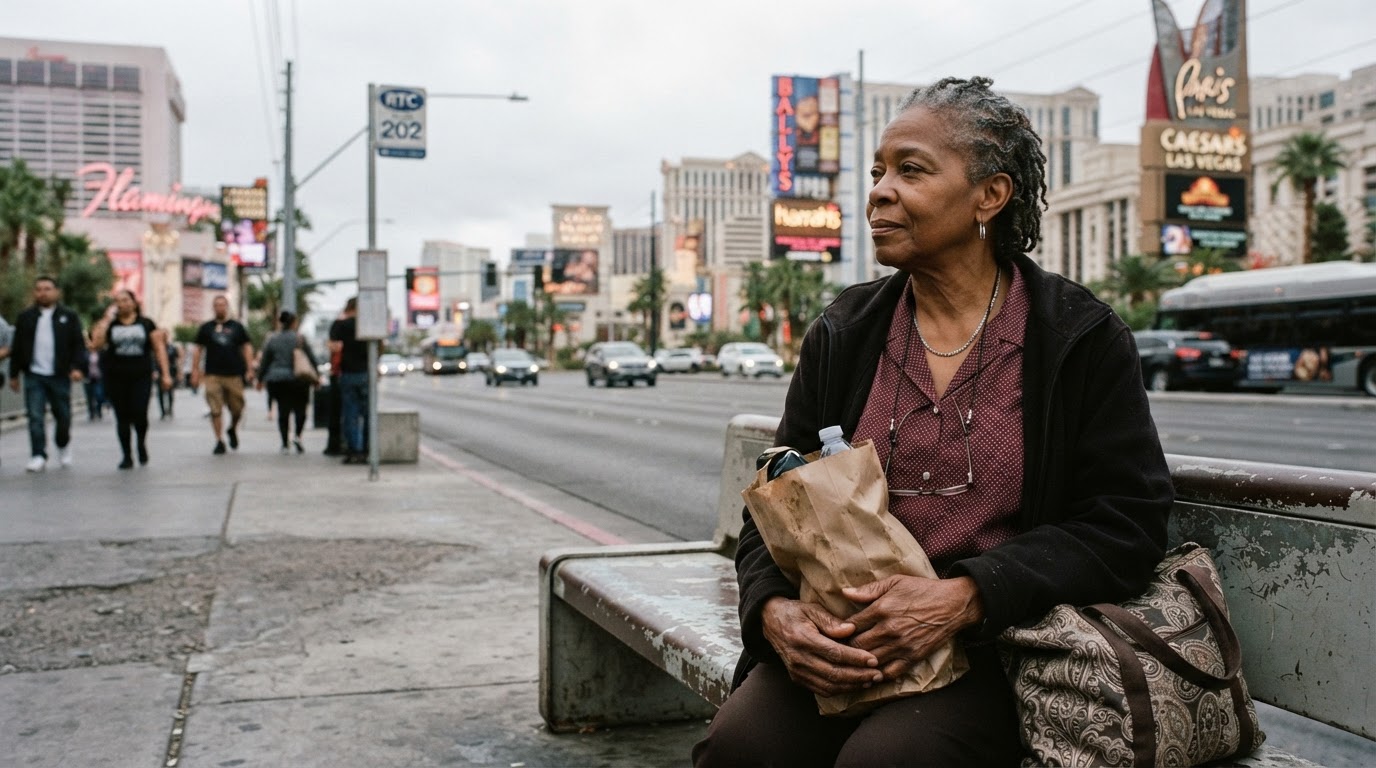
Behind every statistic is a person who had a life before this — and who may have a life after, if the right resources reach them at the right time.
What Housing Insecurity Actually Looks Like in Clark County
It is easy to think of homelessness as the tents under the overpass — and that is part of it. But housing insecurity is much wider than that. It includes people you see every day and would never guess are struggling:
- The hospitality worker who got their hours cut after a slow convention season and could not make rent after one bad month. They are couch-surfing with coworkers, showing up to their shift on time, and hoping nobody notices they have not been home in two weeks.
- The senior on a fixed income whose rent increased beyond what Social Security covers. They are choosing between medication and rent, and the math is not working anymore.
- The family moving between relatives' living rooms every few weeks, trying to keep their children enrolled in the same school district so the kids have one stable thing in their lives.
- The veteran who returned with invisible wounds that made keeping a job impossible. They served their country and now sleep in the shadow of the casinos that define this city to the world.
And then there is the area around Foremaster Lane — what the city has designated the Corridor of Hope, located at 314 Foremaster Lane. It is not a tent city in the way people imagine. It is a cluster of social service agencies — the Courtyard Homeless Resource Center, the Salvation Army, and other providers — that serve as a one-stop location for people seeking help. The city modeled it after a similar approach in San Antonio. The people there are not a problem to be managed. They are neighbors in crisis, and the organizations on Foremaster Lane are doing the work of meeting them with dignity.
Local organizations doing this work every day include HELP of Southern Nevada, which assists families and individuals in breaking down barriers to self-sufficiency; the Nevada Partnership for Homeless Youth, the most comprehensive service provider for young people experiencing homelessness in Southern Nevada; Three Square, Southern Nevada's only food bank and largest hunger-relief organization; and Catholic Charities of Southern Nevada, which provides meals, shelter, and social services to thousands of residents each year.
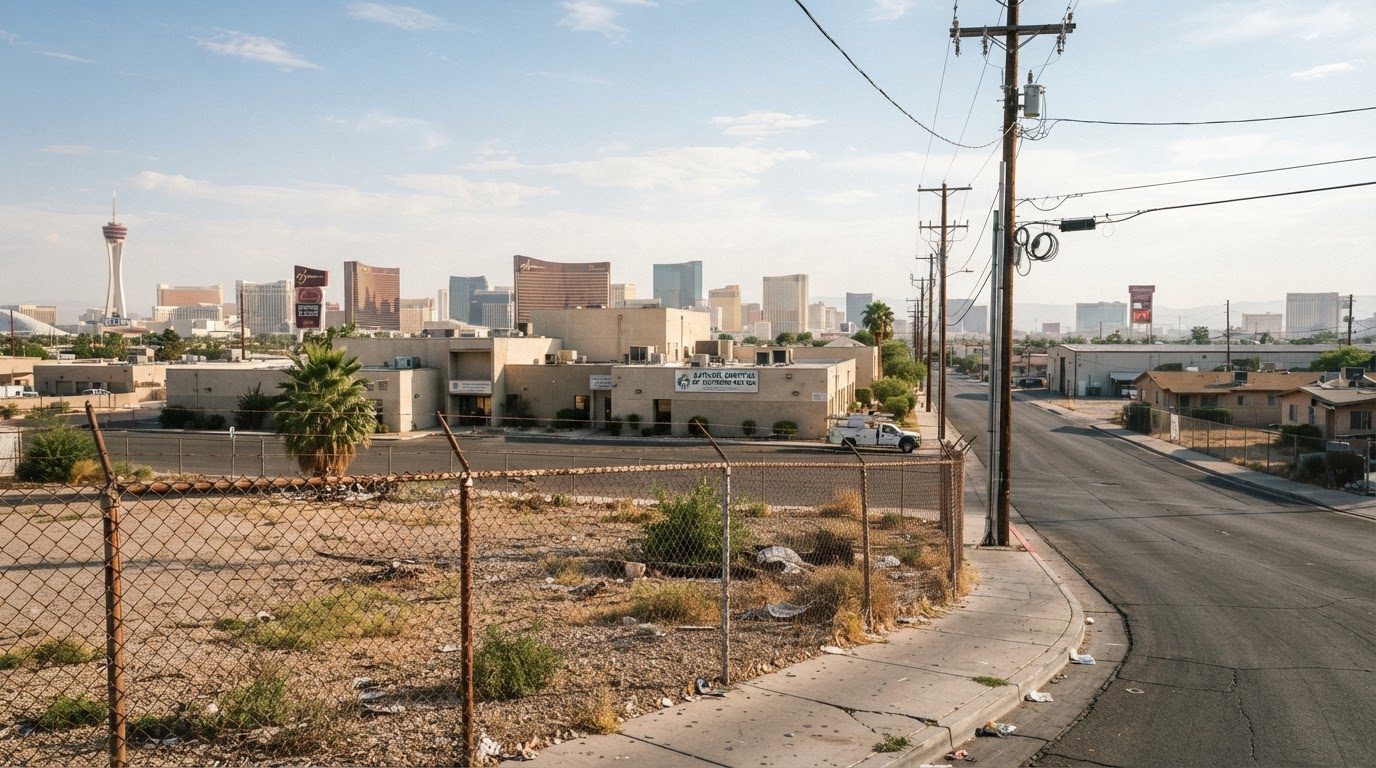
The Foremaster Lane area — designated the Corridor of Hope — where multiple social service agencies provide resources to people experiencing homelessness in Las Vegas.
The Connection Between Homeownership and Community Stability
Research from the Harvard Joint Center for Housing Studies and the Urban Institute consistently shows that homeownership stabilizes communities. When more community members own homes, neighborhoods see lower transience, stronger school enrollment, more civic investment, and more local business support. Homeownership creates a stake — a reason to care about the school board election, the park renovation, the neighborhood watch meeting.
The inverse is also true. When housing instability rises, communities feel it in every institution. Schools see enrollment churn. Healthcare systems absorb the costs of emergency care for unhoused patients. Public safety resources are stretched. Local businesses lose customers. The cost of housing instability is not paid only by the person who loses their home — it is paid by the entire community.
My role in this ecosystem is not just helping individuals buy and sell homes. It is contributing to the housing stability of the community I live in. Every family I help achieve homeownership is a family that has a foundation. Every seller I help maximize their equity is a family that has a financial cushion to weather the next economic shock. That matters — not just to them, but to all of us.
What Las Vegas Is Doing — And Where the Gaps Are
Clark County and the City of Las Vegas are not ignoring this crisis. Several initiatives are in motion:
- Clark County's Coordinated Assessment System provides a centralized intake process for housing services, helping connect people to the right resources faster.
- The Nevada Housing Division administers programs for affordable housing development, including Low-Income Housing Tax Credits that have funded thousands of units across the state.
- The City of Las Vegas Homeless Prevention programs offer rental assistance, case management, and outreach to people living on the streets.
- The Southern Nevada Regional Planning Coalition coordinates housing initiatives across jurisdictions to align policy and funding.
- The Corridor of Hope on Foremaster Lane consolidates multiple service providers into a single location, reducing the barriers people face when seeking help.
But the gaps are real. Nevada has only 14 affordable homes for every 100 low-income households, according to Representative Susie Lee's office, citing National Low Income Housing Coalition data. The state is short an estimated 78,000 affordable rental units for extremely low-income renters. Shelter bed availability does not meet demand. The pipeline of affordable units under construction, while growing, is years behind the need. And wraparound services — mental health care, addiction treatment, job training — are chronically underfunded relative to the scale of the problem.
Progress is happening. It is not fast enough. But acknowledging what is working matters, because it tells us where to invest more.
What Homeowners and Community Members Can Do
You do not have to be a policymaker to make a difference. Here are practical, actionable steps:
- Support local organizations directly. HELP of Southern Nevada, the Nevada Partnership for Homeless Youth, and Three Square all accept donations and volunteers. Your time and your dollars go further than you think.
- Advocate for mixed-income development in your neighborhood and HOA conversations. Research consistently shows that well-designed affordable housing near established neighborhoods does not reduce property values — the stigma is not supported by the data.
- Hire locally. Supporting service workers who may be housing-insecure — tipping well, using local businesses, advocating for hospitality wages — contributes to housing stability at the grassroots level.
- Explore Nevada's ADU (Accessory Dwelling Unit) possibilities. If you have extra space on your property, an ADU can provide a rental unit that adds to the affordable housing supply while generating income for you. Nevada has updated its ADU laws in recent years to make this more feasible.
- Talk about it. Homelessness thrives in silence and stigma. The more we talk about it as a community issue — not a them problem — the more momentum builds for solutions.
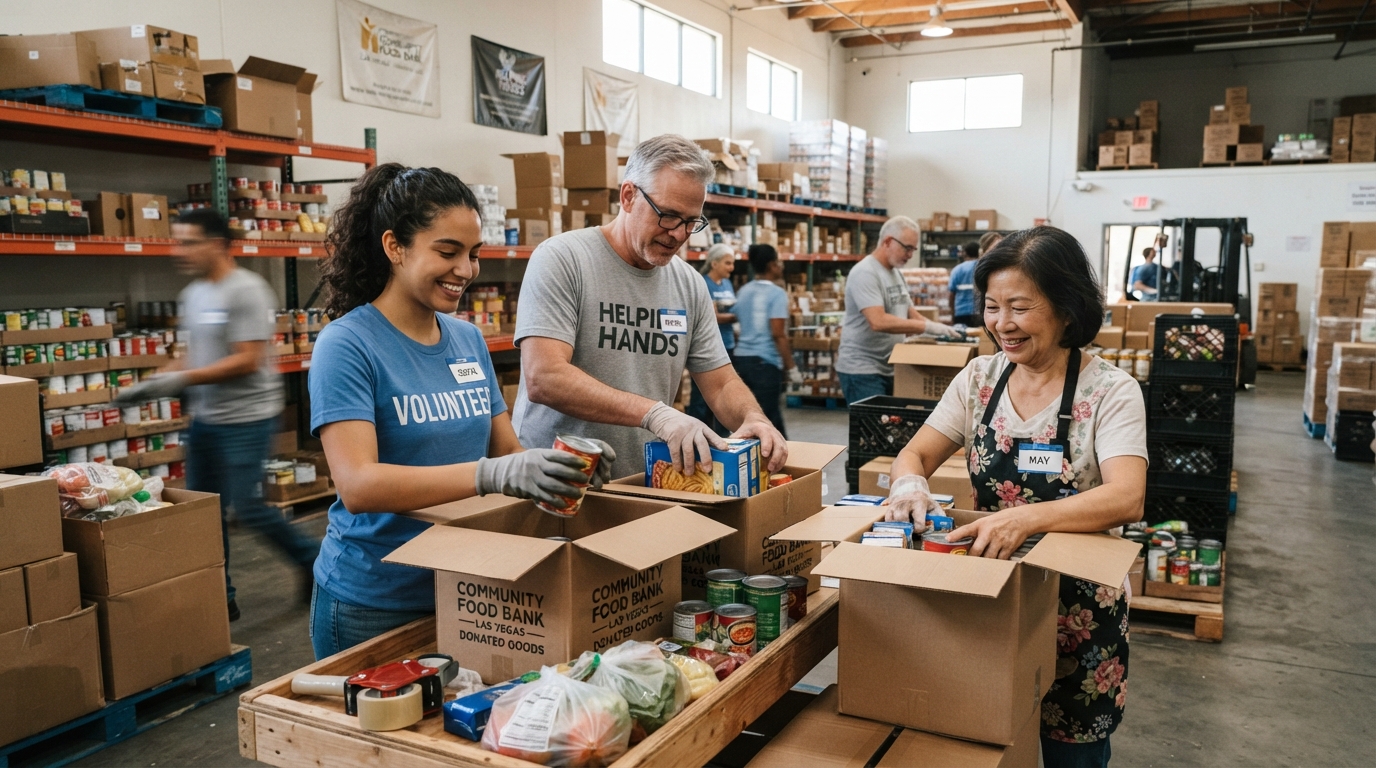
Volunteers at a Las Vegas community food bank — community members supporting each other is one of the most direct ways to address housing insecurity.
The Role of Housing Supply in Solving the Crisis
More housing — at every price point — is essential to reducing scarcity pressure. When supply is constrained, prices rise. When prices rise, the people at the bottom of the income ladder are the first to lose their footing. This is not ideology. It is economics.
Mixed-income development, ADUs, multifamily zoning reform, and public-private partnerships all contribute to a broader housing supply. Every unit built at an affordable price point is one fewer family at risk of losing their housing. Every unit built at a market rate is one fewer buyer competing for the existing affordable stock.
My role in this is specific but meaningful. Helping people build equity and housing stability through homeownership is a direct contribution to the solution. A family that owns their home has a financial foundation that renting does not provide. A well-sold home that generates strong equity gives a family the resources to weather future economic shocks without falling into housing insecurity. The work I do through The Lockhart Method is not separate from this crisis — it is one piece of a much larger puzzle.
I do not have a policy solution. I am a REALTOR, not a legislator. What I do know is that communities where more people have stable housing are better communities for everyone who lives there — including homeowners. This is one of those issues where our interests align even when we think they do not.
Where We Go From Here
The Las Vegas I love is a city of second chances. People come here to start over, to reinvent, to build something from nothing. That spirit is real, and it is worth protecting. But a city cannot be a city of opportunity if thousands of its residents cannot access the most basic foundation of a stable life: a safe place to sleep.
The data is clear. The causes are understood. The organizations doing the work are underfunded but effective. The gap between what is needed and what is being done is real, but it is not permanent.
If you are looking to make homeownership part of your own stability plan — whether you are buying for the first time or leveraging equity you have already built — I am here for that conversation. And if you want to support the community organizations doing this work daily, I have linked them all below.
Organizations Making a Difference in Las Vegas
- HELP of Southern Nevada — Direct services, training, and referrals for families and individuals
- Nevada Partnership for Homeless Youth — Comprehensive services for young people experiencing homelessness
- Three Square Food Bank — Southern Nevada's only food bank, addressing food insecurity
- Catholic Charities of Southern Nevada — Meals, shelter, and social services
- Salvation Army Las Vegas — Emergency shelter, rehabilitation, and family services
About the Author
Steven D. Lockhart is a licensed Nevada REALTOR® (License #S.0194053) specializing in residential listings, buyer representation, and real estate solutions for life transitions including divorce, probate, and senior relocations. Based in Las Vegas, NV, he serves the greater Las Vegas Valley including Henderson, Summerlin, North Las Vegas, and surrounding communities. Learn more at stevelockhartrealtor.com.
Disclaimer: This post is for informational and community awareness purposes only. It does not constitute legal, financial, or policy advice. Statistics are drawn from publicly available sources including the Clark County Point-in-Time Count, the Nevada Governor's Office of Economic Development, the National Low Income Housing Coalition, and local news reporting. Always consult with appropriate professionals regarding your specific circumstances.
Related resources: Home Search, First-Time Home Buyer, Home Value, The Lockhart Method, Schedule a Call

Steve Lockhart
Las Vegas Real Estate Strategist
Steve Lockhart spent nearly 30 years in MGM Resorts executive leadership, from the opening team of The Mirage to Director of Slot Operations at MGM National Harbor, before becoming a Las Vegas Realtor® in 2021. He built The Lockhart Method™ to bring that same high-stakes negotiation and leadership experience to real estate's toughest transitions: divorce, probate, senior downsizing, and distressed property sales.
Learn More About Steve