 Translate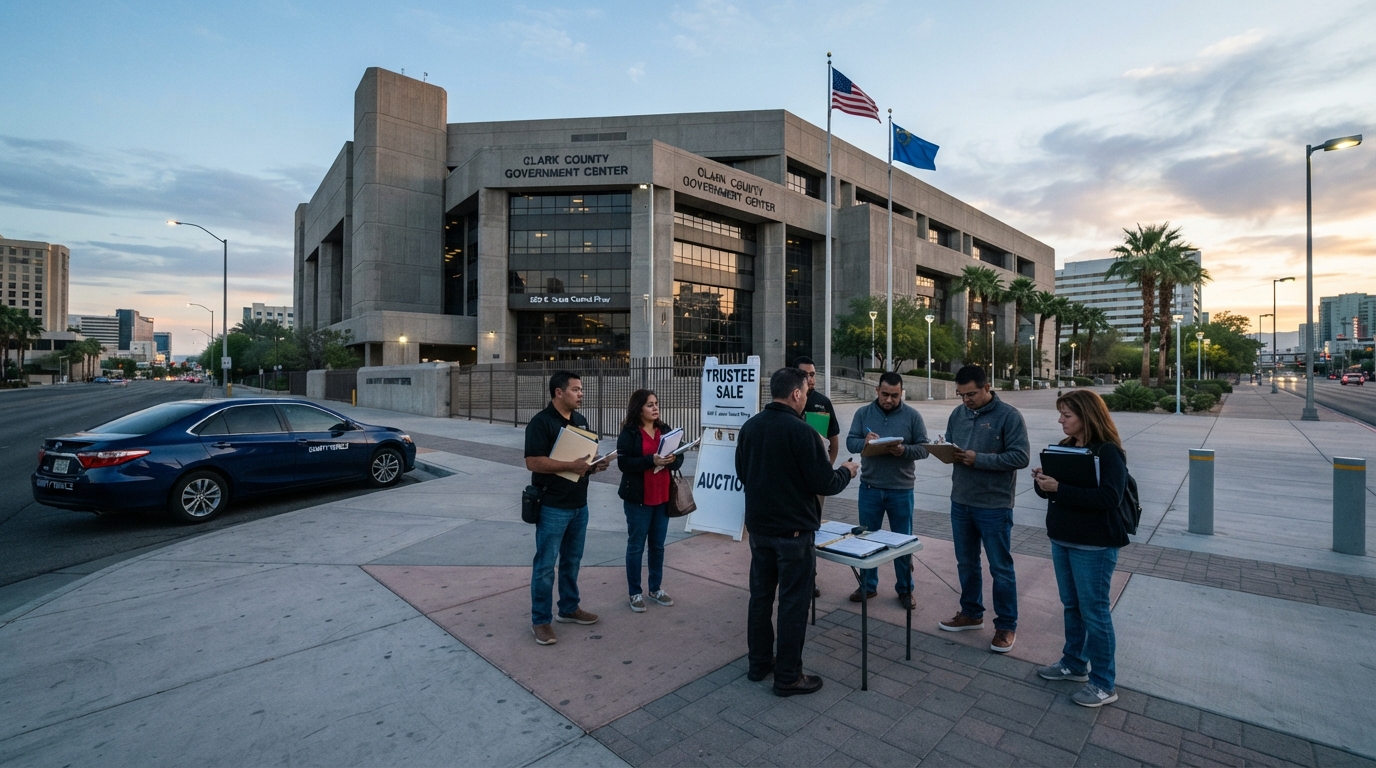
Buying a Home at a Clark County Property Auction in 2026: The Real Process, Real Risks, and What Most Buyers Learn Too Late
Auction properties can represent real value — buying below market, acquiring distressed assets, finding deals that do not exist in the traditional listing environment. The appeal is real. So are the risks.
The gap between the TV version of auction buying and the actual Clark County process is wide enough to cost an unprepared buyer tens of thousands of dollars. This guide closes that gap.
I have seen buyers walk away from auctions with genuine deals. I have also seen buyers win a bid and inherit a mess they did not expect — liens, title issues, interior condition surprises — that cost more to resolve than the discount was worth. The difference was almost always preparation.
Clark County trustee sales are public auctions — typically held at the county building or online via platforms like Auction.com.
How Nevada's Non-Judicial Foreclosure and Trustee Sale Process Works
Nevada does not require a court to foreclose — this makes the process faster than in judicial states. The lender follows a statutory process without filing a lawsuit.
After a Notice of Default is recorded and the 3-month waiting period passes, the lender records a Notice of Sale. The property then goes to a trustee sale — a public auction typically conducted at the Clark County courthouse steps or via an online auction platform (often Auction.com or similar).
The opening bid is typically the amount owed to the foreclosing lender plus fees. Bidding is open to the public — any registered participant can bid. The highest bid wins, and the sale is final, typically with no contingency period.

Preparation is everything. A title search, lien check, and exterior inspection before bidding can save you from costly surprises.
What You Must Know Before You Bid — The Non-Negotiables
Cash Requirement
Most Nevada trustee sales require payment in full on the day of the sale — typically by cashier's check. Financing is almost never available at the auction stage. If you win and cannot pay, you forfeit your deposit and may face penalties. This single requirement eliminates most traditional homebuyers from the auction process.
No Inspection Contingency
You are bidding on a property you may not have been able to inspect inside. Condition is unknown — deferred maintenance, damage, code violations, or worse. What you see from the exterior and public records is what you have to work with. There is no inspection period, no repair request, no walk-away clause after the gavel falls.
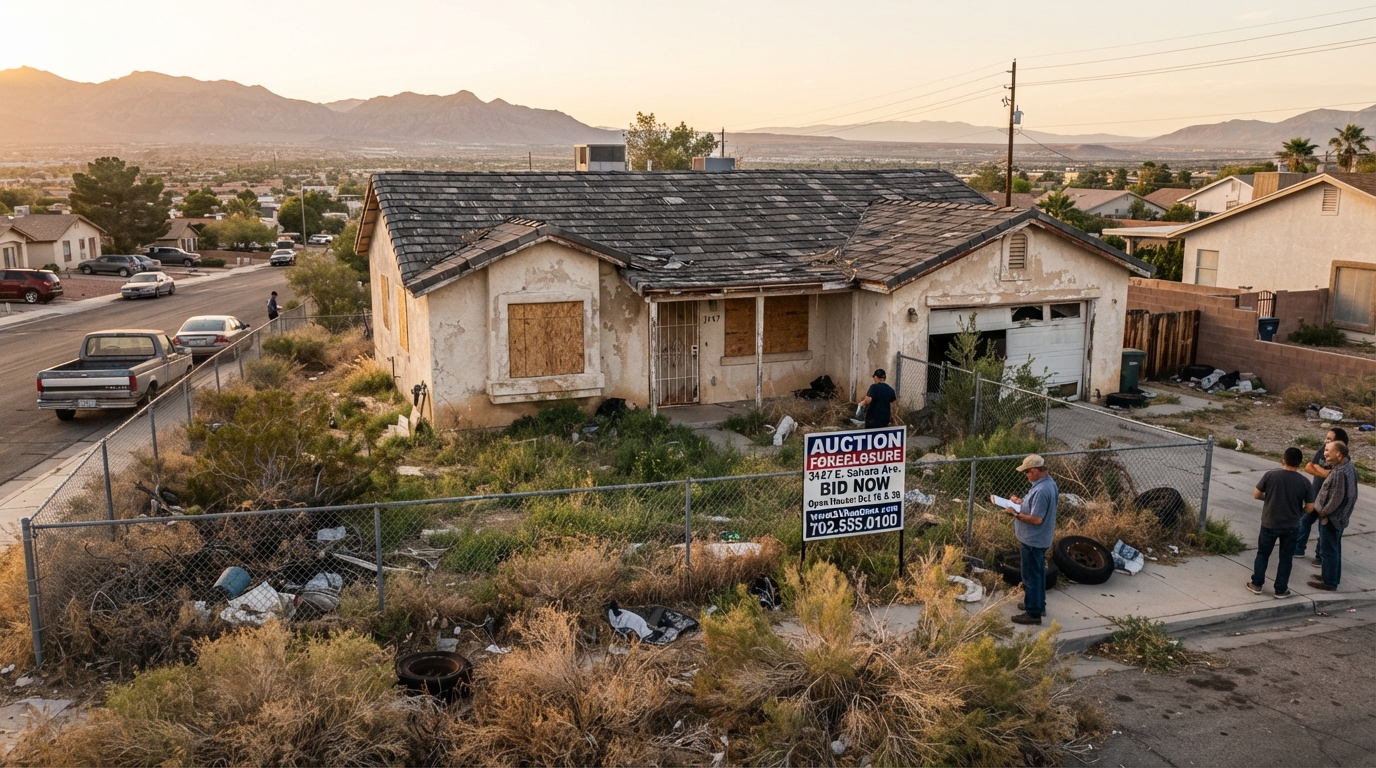
Auction properties are sold as-is. You may not be able to inspect the interior before bidding. What you see from the street is what you get.
Title Complexity
A foreclosure sale extinguishes the first mortgage lien, but may NOT clear all junior liens. Second mortgages, HOA liens, IRS tax liens, and mechanic's liens may survive the sale. A thorough title search before bidding is mandatory — not optional. If you win without clearing title issues, you inherit them. Always order a preliminary title report before bidding.
Redemption Rights
Nevada has a limited redemption period after a trustee sale in certain circumstances. Understand whether this applies to the property you are bidding on and what it means for your ownership timeline. Consult a Nevada real estate attorney for specifics.
Finding Auction Properties in Clark County
Auction properties are not listed on the MLS. Here is where to find them:
- Auction.com: The largest platform for online foreclosure auctions. Many Clark County sales now happen here, with properties listed days or weeks before the auction date.
- Clark County public trustee sale notices: Filed with the county and publicly available. These are the official legal notices of upcoming sales.
- ATTOM Data / RealtyTrac: Track pre-foreclosure and auction properties before they hit the auction block. These services provide data on properties entering the foreclosure pipeline.
- Driving neighborhoods: Pre-foreclosure properties are sometimes visible before auction status. Look for signs of distress — overgrown landscaping, accumulated mail, boarded windows.
- Working with a REALTOR who tracks pre-auction inventory can give you earlier access to properties before they reach the public auction stage.
The Smart Buyer's Pre-Bid Checklist
Before you ever raise a paddle or click a bid button, complete this checklist:
- Pull the full title report from a Nevada title company. Cost: $150 to $300. Worth every dollar. This reveals all recorded liens against the property.
- Search Clark County records for all recorded liens — HOA liens, IRS tax liens, judgment liens, mechanic's liens. Any lien that survives the foreclosure sale becomes your responsibility.
- Drive the property and inspect from the exterior. Note condition, apparent damage, occupancy status. Is the home occupied? An occupied home after auction means you may need to pursue eviction.
- Determine your maximum bid based on: estimated after-repair value (ARV) minus estimated repair costs minus your target margin. Write this number down. Do not exceed it in the room.
- Register for the auction and have your cashier's check ready before the auction date. Auction platforms require pre-registration and proof of funds.
- Know your walk-away number before you bid. Auctions create emotional momentum. The buyers who get hurt are the ones who bid above their pre-determined limit.
- Understand the redemption period and what it means for your ownership timeline. Consult a Nevada real estate attorney for specifics on any property you are seriously considering.
The buyers who succeed at auction are the ones who did their homework weeks before the sale date. The ones who fail are the ones who showed up, saw a property, and bid on emotion. Preparation is the entire game.
Pre-Foreclosure vs. Auction — Which Is Actually the Better Opportunity?
This is the comparison most buyers do not make — and it matters more than you might think:
| Factor | Pre-Foreclosure (Before Auction) | Trustee Sale Auction |
|---|---|---|
| Inspection possible | Usually yes | Rarely |
| Financing available | Yes | Almost never |
| Negotiation possible | Yes | No |
| Title clarity | Full title search, insurance available | Requires independent research, limited insurance |
| Condition knowledge | Higher | Lower |
| Competition | Lower | Higher (experienced investors) |
| Price | Slightly higher | Potentially lower (but with hidden costs) |
In my experience, pre-foreclosure purchases often represent better net value for most buyers than auction wins — primarily because you can inspect, finance, and insure the transaction conventionally. The auction discount is real, but so is the risk premium.

For most buyers, a pre-foreclosure purchase offers better net value than an auction win — you can inspect, finance, and insure conventionally.
What Rising Foreclosure Activity Means for Buyers in Las Vegas in 2026
Pre-foreclosure filings in Clark County have been increasing as post-pandemic affordability pressures, rising interest rates, and the end of forbearance cycles converge. According to data from ATTOM Data Solutions, Nevada has seen elevated pre-foreclosure activity relative to pre-2020 levels.
More inventory coming through the auction channel means more opportunities — but also more competition from professional investors. Professional iBuyers and fix-and-flip investors operate in this space with significant advantages: cash on hand, speed, and established due diligence systems that let them evaluate properties in hours.
Individual buyers can compete by focusing on: specific property types that institutional investors pass over, specific neighborhoods where you have local knowledge, and thorough preparation that matches what the professionals do. The key advantage an individual buyer has is flexibility — you do not need to hit a specific volume target, so you can wait for the right property.
Timing matters. The pre-foreclosure stage offers the best opportunity for individual buyers — before professional auction investors dominate the process. If you are interested in short sales or distressed properties, those represent an earlier entry point with more buyer protections.
Frequently Asked Questions
How do I buy a house at auction in Las Vegas?
Clark County trustee sales are public auctions held at the county courthouse or online via platforms like Auction.com. You must register in advance, bring a cashier's check for the full purchase amount, and bid against other participants. The highest bid wins and the sale is final with no contingency period. Before bidding, complete a title search, lien check, exterior inspection, and set a maximum bid based on estimated after-repair value minus repair costs minus your target margin.
What are the risks of buying a foreclosure at auction in Nevada?
The primary risks are: unknown interior condition since you typically cannot inspect before bidding, surviving junior liens (HOA, IRS, mechanic's liens) that become your responsibility, cash-only requirement with no financing available, no contingency period or right to walk away after winning, and potential occupancy issues requiring eviction. A preliminary title report and exterior inspection are the minimum due diligence before any bid.
How does a trustee sale work in Nevada?
Nevada uses a non-judicial foreclosure process. After a Notice of Default is recorded and a 3-month waiting period passes, the lender records a Notice of Sale. The property is then auctioned at a public trustee sale. The opening bid is typically the amount owed to the foreclosing lender plus fees. The highest bidder wins, pays by cashier's check, and receives a trustee's deed. The sale is final with no contingencies.
Can I inspect a home before buying it at auction in Las Vegas?
In most cases, no. Auction properties are sold as-is and you typically cannot access the interior before bidding. You can drive the property, inspect from the exterior, check public records, and order a preliminary title report — but you cannot schedule a professional home inspection or walk through the home. This is one of the primary reasons pre-foreclosure purchases often represent better value for most buyers than auction wins.
Do I need cash to buy a home at a Clark County auction?
Yes, in almost all cases. Nevada trustee sales typically require payment in full on the day of the sale, usually by cashier's check. Financing is almost never available at the auction stage. If you win the auction and cannot pay, you forfeit your deposit and may face additional penalties. This cash requirement is one of the main barriers that keeps most traditional homebuyers out of the auction process.
What happens if I win a bid at a Nevada property auction?
If you win, you pay the full bid amount by cashier's check on the day of the sale. You receive a trustee's deed, which transfers ownership. However, the property may still have surviving junior liens that did not get extinguished by the foreclosure. You may also need to handle eviction if the property is occupied. There is no inspection period, no financing contingency, and no right to walk away after the gavel falls. Title insurance may be limited until any clouded title issues are resolved.
Ready to Talk? Here Is Your Next Step
If you are interested in pre-foreclosure and distressed property opportunities in Las Vegas, this is an area I track closely. A no-obligation conversation can help you understand what is actually available and how to evaluate it intelligently — whether you are considering an auction, a pre-foreclosure purchase, or a short sale.
You can also explore distressed property options, compare selling options, or browse Las Vegas homes for sale on the traditional market.
About the Author
Steven D. Lockhart is a licensed Nevada REALTOR® (License #S.0194053) specializing in residential listings, buyer representation, and real estate solutions for life transitions including divorce, probate, and senior relocations. Based in Las Vegas, NV, he serves the greater Las Vegas Valley including Henderson, Summerlin, North Las Vegas, and surrounding communities. Learn more at stevelockhartrealtor.com.
Disclaimer: This post is for informational purposes only and does not constitute legal or financial advice. Nevada foreclosure law is complex and situation-specific. Always consult with a licensed Nevada real estate attorney before participating in any property auction. Tax implications should be discussed with a licensed CPA.
Related resources: Distressed Properties, Short Sale, Compare Selling Options, Las Vegas Homes for Sale, First Time Home Buyer, Investor Properties, Schedule a Call

Steve Lockhart
Las Vegas Real Estate Strategist
Steve Lockhart spent nearly 30 years in MGM Resorts executive leadership, from the opening team of The Mirage to Director of Slot Operations at MGM National Harbor, before becoming a Las Vegas Realtor® in 2021. He built The Lockhart Method™ to bring that same high-stakes negotiation and leadership experience to real estate's toughest transitions: divorce, probate, senior downsizing, and distressed property sales.
Learn More About Steve